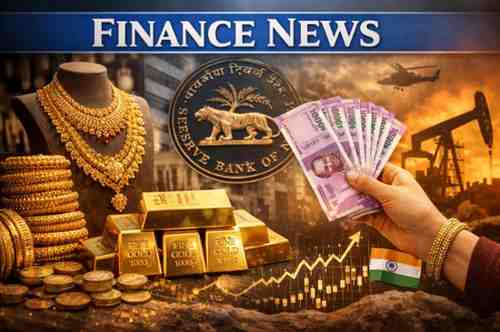
At a jewellery shop in south Delhi on a January morning, the soft glow of gold necklaces under display lights belies a much sharper reality outside. Prospective buyers, ledger books in hand, pause at prices that till recently would have sounded unbelievable. “I remember when 10 grams of 22 carat gold used to cost under ₹50,000,” says Sunita Dixit, a schoolteacher in her mid-50s, her voice mixing nostalgia with disbelief. Today the same quantity sits around ₹1,25,000.
This seemingly perpetual ascent of gold prices has become one of the most compelling financial stories in India over the past eighteen months. For a nation whose relationship with gold is as much cultural as financial, the latest prices are not just figures. They are markers of global uncertainty, shifting economic policy, and deeply personal choices.
From Cultural Symbol to Investment Anchor
Gold’s place in Indian life is unique. It adorns brides on wedding days, marks festivals like Diwali and Dhanteras, and sits quietly in lockers as a form of long-term security. Yet in recent years, its role has shifted sharply toward that of an investment instrument and macroeconomic hedge.
During FY2025, domestic gold prices rose dramatically, outperforming several traditional asset classes. Analysts tracking MCX data estimate that gold prices climbed roughly 32 percent over the fiscal year, driven by sustained investor demand and mounting global risk. Equity markets, while volatile, did not deliver the same sense of certainty for many households.
“People are buying gold more for safety than sparkle,” says Rohan Batra, a Mumbai-based commodity strategist. “When interest rate paths are unclear and currencies weaken, gold feels tangible and dependable.” His view mirrors a broader global pattern where precious metals regain prominence whenever confidence in financial systems wavers.
Global Shocks, Local Repercussions
If one word defines the gold market in late 2025 and early 2026, it is uncertainty. Investors are navigating a fragile global economy shaped by slowing growth in major economies, expectations of policy easing by the US Federal Reserve, and persistent geopolitical flashpoints.
At the start of January 2026, gold prices edged higher worldwide as traders priced in the likelihood of rate cuts later in the year. Lower interest rates typically support gold because the metal does not yield interest, making it more attractive when bond returns fall.
Geopolitics added another layer. News of escalating US military action in Venezuela sent tremors through global markets, pushing investors toward safe-haven assets. Gold, oil, and select currencies saw immediate reactions, reinforcing the metal’s role as a refuge during geopolitical stress.
For Indian buyers, these global developments translate quickly into local prices, amplified by currency movements and import costs. A softer rupee makes gold imports more expensive, even if global prices remain stable.
Policy Shifts, Import Duties, and the Shadow Economy
Domestic policy has also played a decisive role in shaping gold’s trajectory. In the Union Budget for 2024–25, the Indian government sharply reduced customs duties on gold imports from 15 percent to 6 percent. It was the lowest rate in more than a decade and was aimed at curbing smuggling while making legal imports more attractive.
The immediate effect was an increase in official gold imports, improving transparency and reducing some pressure on the grey market. However, high absolute prices have created unintended consequences.
In recent weeks, customs officials at several international airports reported significant seizures of smuggled gold. At Chennai airport alone, authorities intercepted gold worth approximately ₹1 crore concealed on a passenger arriving from Southeast Asia. Similar cases have been reported in Mumbai and Kochi.
Such incidents underline a persistent tension. When gold prices rise rapidly, even reduced duties can leave room for illicit trade, especially when demand remains strong and enforcement gaps exist.
Household Decisions and Emotional Economics
For Indian households, gold prices are not an abstract macroeconomic debate. They influence wedding budgets, inheritance planning, and everyday savings decisions. In states like Kerala and Tamil Nadu, where gold ownership is deeply embedded in social tradition, families plan purchases months in advance, hoping to time the market.
Rising prices are also changing behavior. Some buyers are opting for lighter jewellery designs, while others are turning to gold-plated alternatives for ceremonial use. Digital gold, sovereign gold bonds, and gold exchange-traded funds are attracting younger investors who want exposure without the burden of storage or making charges.
“There is definitely a shift,” says a senior executive at a national jewellery chain. “Older customers still want physical gold, but younger buyers are comfortable owning it on an app.”
What Comes Next
Forecasts for gold prices in 2026 vary widely. Some analysts believe continued geopolitical instability and central bank easing could push prices even higher. Others warn that the market may be vulnerable to corrections if global growth stabilizes or inflation eases faster than expected.
What is clear is that gold has reclaimed its place at the center of India’s financial consciousness. It is no longer just a symbol of prosperity or tradition. It is a barometer of anxiety, confidence, and global interconnectedness.
Back in the Delhi jewellery store, Sunita finally selects a modest bracelet, lighter than what she originally planned. “Gold still feels safe,” she says quietly, “but now it also feels expensive in an emotional way.”
In today’s India, gold is not merely a metal. It is a reflection of the times.
Leave a Reply