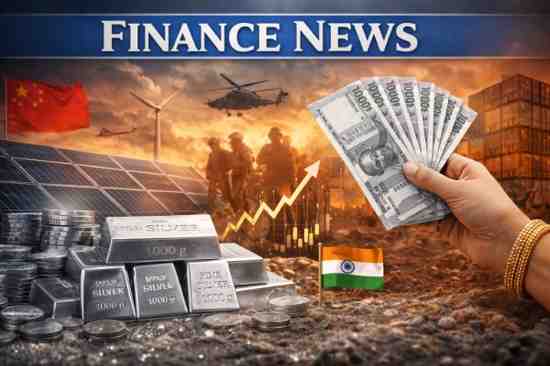
For decades, silver played the quiet second fiddle to gold in India’s cultural and financial life, valued for wedding gifts and religious rituals but rarely commanding headlines. On a cold January morning in Mumbai’s Zaveri Bazaar, the city’s historic bullion district, trader Anil Shah stood staring at the price ticker in disbelief. “Two years ago, silver at ₹1 lakh per kilogram felt expensive,” he said. “Now we are talking about ₹2.5 lakh, and buyers still keep calling.”
As of today, silver prices in India hover around ₹2,55,000 to ₹2,60,000 per kilogram in major markets, with per-gram rates near ₹2,550. The day-to-day movement may look modest, but the longer arc tells a dramatic story. Silver has quietly delivered one of the most aggressive rallies among major commodities, forcing investors, manufacturers, and households to rethink its role.
A Rally That Refuses to Stay Quiet
Silver’s price surge did not happen overnight. Over the course of 2025, the metal climbed relentlessly, at one point touching record highs on domestic futures exchanges. In percentage terms, it outperformed gold and many equity indices, driven by a potent mix of investor anxiety, industrial demand, and supply constraints.
At the start of 2026, markets entered a phase of consolidation. Prices have paused, occasionally slipping on profit-booking before finding support again. Traders describe the market as tense but resilient. “This is not speculative froth alone,” said a senior commodities broker in Ahmedabad. “There is real demand underneath the price.”
Globally, silver trades at elevated levels, supported by expectations that major central banks may ease interest rates later in the year. Lower rates typically weaken currencies and increase the appeal of precious metals, especially those like silver that straddle the line between monetary asset and industrial raw material.
The Industrial Engine Behind Silver’s Rise
Unlike gold, silver’s value is deeply tied to modern industry. It is a critical component in solar panels, electric vehicles, electronics, and advanced telecommunications. As countries accelerate their clean-energy transitions, silver demand has expanded rapidly.
In India, this industrial pull is becoming increasingly visible. Manufacturers of solar modules and electronic components are watching silver prices as closely as currency markets. “Every spike hits our cost structure immediately,” said Lakshmi Narayan, an engineer at a renewable energy firm in Tamil Nadu. “When silver becomes volatile, long-term pricing becomes difficult.”
The problem is supply. Silver production has remained relatively flat globally because much of it comes as a by-product of mining other metals like copper and zinc. That limits how quickly output can respond to rising demand. Industry estimates suggest that the silver market has run persistent supply deficits for several years, gradually draining above-ground inventories.
Geopolitics Enters the Picture
Silver’s rally is not driven by economics alone. Geopolitics has become an increasingly important factor. Recent policy moves by major producing and refining countries have tightened global supply chains. China, in particular, has implemented stricter export controls on certain metals, including silver, prioritizing domestic industries tied to energy transition and strategic manufacturing.
Market participants interpret these moves as structural rather than temporary. Reduced export availability means importing countries like India face higher procurement costs and longer lead times. Traders describe a market that is no longer just price-driven, but logistics-driven.
“This is what makes silver dangerous and exciting at the same time,” said a metals analyst based in Singapore. “When supply becomes political, price discovery changes completely.”
Investor Psychology: Between Conviction and Caution
Among investors, silver has triggered a rare mix of conviction and fear. Retail participation has surged, particularly through commodity exchanges and digital investment platforms. Online forums are filled with debates about whether silver is entering a multi-year supercycle or nearing an inevitable correction.
Some investors argue that the fundamentals justify higher prices. They point to structural supply shortages, growing industrial demand, and global monetary easing. Others warn that the pace of the rally itself is a red flag.
“When prices rise this fast, corrections are natural,” said a Mumbai-based portfolio manager. “The key question is whether dips are being bought aggressively. So far, they are.”
Silver’s volatility remains significantly higher than gold’s, making it attractive to traders but nerve-wracking for conservative savers.
The Household Impact No One Talks About
Away from trading desks, silver’s rise is reshaping everyday decisions. In Jaipur, traditional silver jewellery workshops are adjusting designs to use less metal. In rural Uttar Pradesh and Rajasthan, families planning weddings are scaling back customary silver gifts or switching to lighter coins.
“Earlier, silver was the affordable metal,” said Meena Devi, a teacher in eastern Uttar Pradesh. “Gold felt aspirational. Now silver also feels out of reach.”
Retail jewellers report that while demand remains steady, buyers are increasingly price-sensitive. Many are delaying purchases or opting for installment plans. Others are turning to silver exchange-traded products to gain exposure without physical possession.
Is This a New Era for Silver?
Forecasts for silver in 2026 vary widely. Some analysts believe prices could climb further if industrial demand continues to grow and supply remains constrained. Others expect periods of sharp correction, especially if global growth stabilizes or interest rate expectations change abruptly.
What is clear is that silver is no longer a background commodity. It has become a strategic asset, shaped by clean-energy policy, geopolitical decisions, and shifting investor psychology.
Back in Zaveri Bazaar, Anil Shah finally looked away from the ticker. “Silver used to be predictable,” he said quietly. “Now it tells you how nervous the world really is.”
In today’s market, silver is not just a metal. It is a mirror of global transition, uncertainty, and ambition.
Leave a Reply